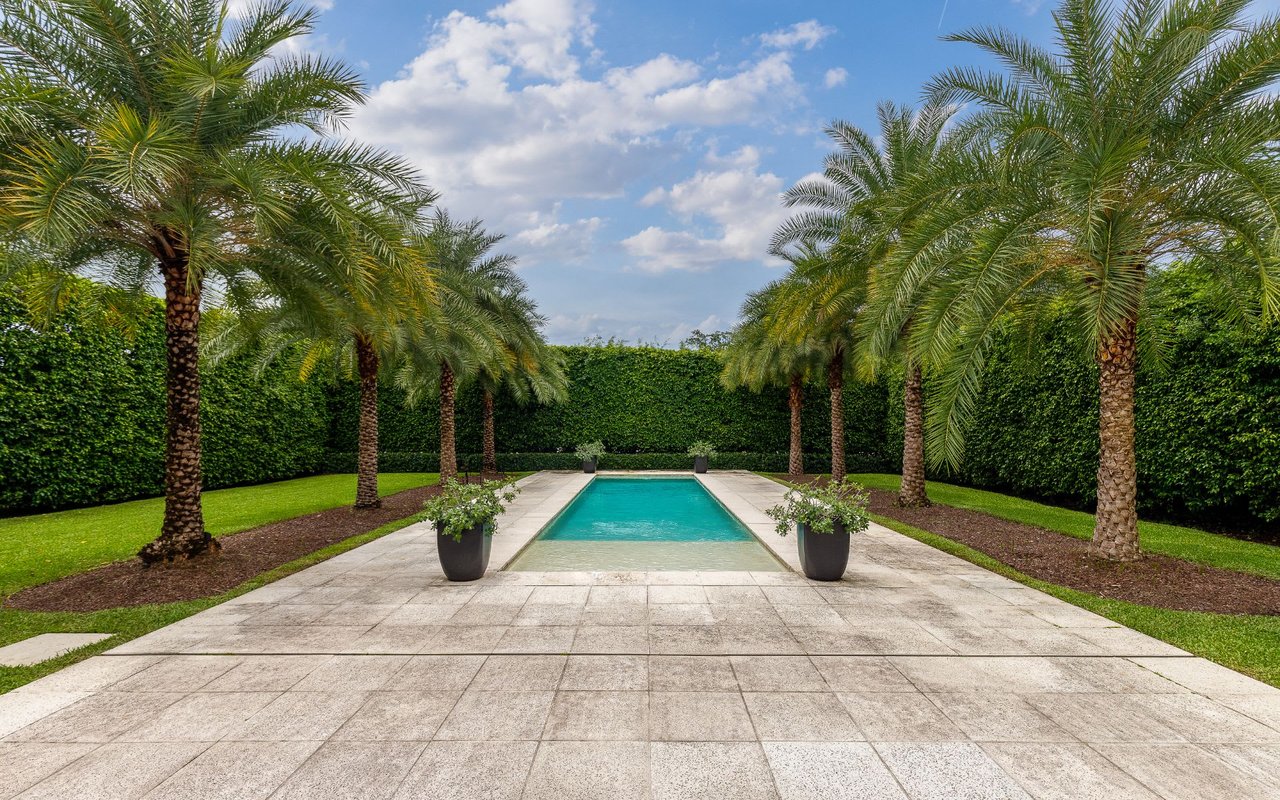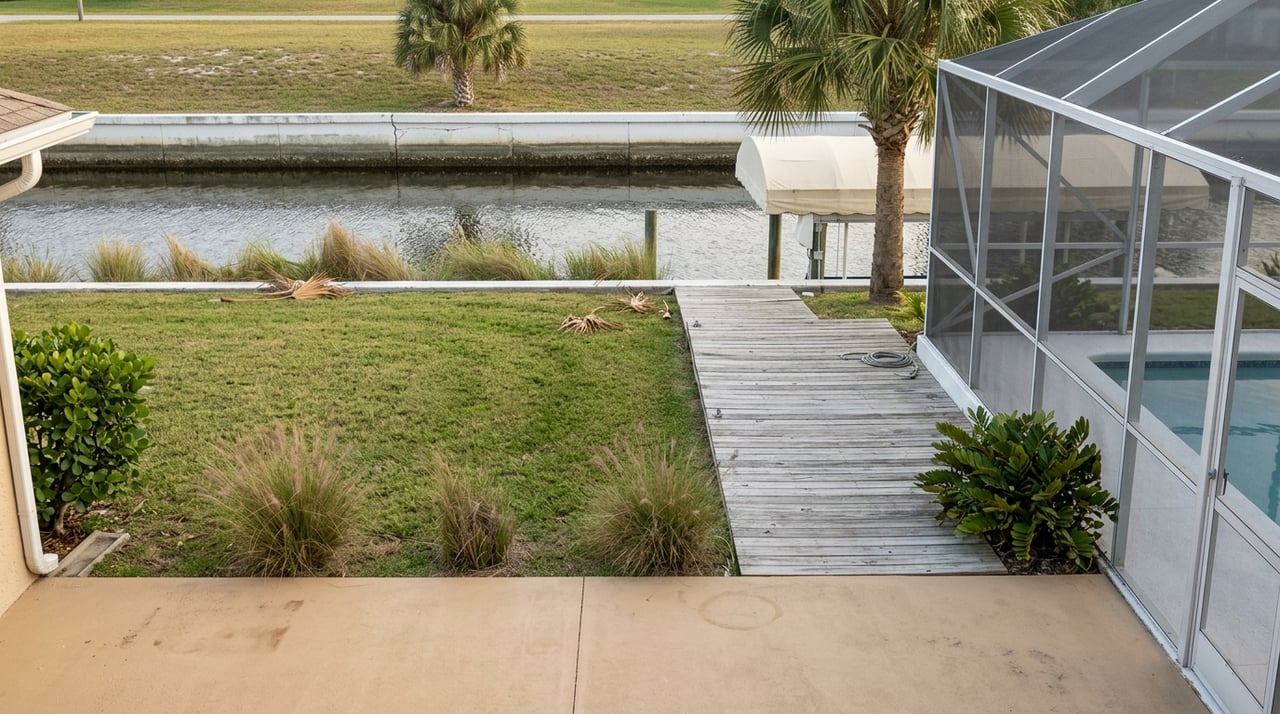
Picture two canal-front listings in Palm Harbor, a street or two apart. Both say "waterfront." Both show a private dock in the photos. Both back up to a saltwater canal that empties into the Intracoastal. Under the neighborhood's current price bands, one could realistically sit in the high $300s. The other could clear $700,000.
The difference is not the house. It is not the lot size or the year it was built. It is a fixed bridge somewhere between that dock and open water, and whether a boat with any real mast height or draft can get under it.
That single detail, more than square footage, more than the kitchen, is what actually prices a Palm Harbor canal home. Buyers who shop the neighborhood on price per square foot alone are pricing the wrong thing.
Three Waterfronts, One Neighborhood
Palm Harbor is Palm Coast's original saltwater canal district, laid out in the 1970s when the ITT Community Development Corporation carved the city's numbered and lettered sections out of what had been ranch and timber land. The company's first residents moved in during January 1972, and by 1975 more than 38,000 lots across the young city had already sold, according to the Flagler County home insurance guide from LiveCovered, which draws that figure from the Palm Coast Historical Society. A lot of what stands in Palm Harbor today dates back to that first wave.
What ITT built was not one waterfront. It was a graded system, and the grade is set by bridges. Homes with no fixed bridge between the dock and the Intracoastal, an area longtime locals call Sailboat Country, currently trade at $700,000 and up. Homes on a canal that still reaches the Intracoastal but has to pass under a bridge along the way land in a wide middle band, roughly the high $300s to $600s, where the dock and seawall condition do most of the work deciding the final number. Dry lots with no canal frontage at all sit at the floor, starting in the high $200s, and get you into the neighborhood without any of the water-related carrying costs.
Canal Position | Typical 2026 Price Band | What Actually Sets the Price |
|---|---|---|
Dry lot, no canal frontage | High $200s | No dock or seawall to inspect, maintain, or insure |
Bridged canal, standard canal-front | High $300s to $600s | Private dock, but a fixed bridge limits boat size and mast height |
No-fixed-bridge Sailboat Country, wide-water | $700K and up | Unbroken run to the Intracoastal |
The spread inside that middle band is wide on purpose. A canal-front home with a documented new roof and a sound seawall sells at the top of it. The same house with an aging seawall and an unpermitted dock repair sells near the bottom, no matter how the listing photos look.
Where the Bridges Actually Sit
The bridges are not evenly distributed, which is part of why one street can price so differently from the next. In the numbered canal sections that make up the older core of the district, Section 16 has three low fixed bridges to clear, at Colorado, at Colchester, and at the Yacht Club. Sections 2 through 6 have a single bridge to pass, near the marina. Sections 14 and 15, the heart of Sailboat Country, have none.
That absence of a bridge is the entire premium. A sailboat with a swing keel or a deep-draft cruiser can clear the water in 14 and 15 without planning a route around anything. A boat of the same size in Section 16 has to fit under three separate spans, and if it can't, the dock in the listing photo is decorative.
Longtime canal residents describe this in practical terms rather than real estate terms. Barry Kipnis, a member of the Palm Coast Yacht Club who has boated for more than 50 years and bought his home for the water access, told the Palm Coast Observer that the canal system has "gotten shallower, it's silted in" over the years he's lived there. That kind of firsthand read, this stretch is tighter than it used to be, this one still runs fine, is not something a listing sheet will tell you. It is something you find out by asking someone who has actually taken a boat through it.
The City's Own Numbers Prove the Point
In 2023, Palm Coast commissioned a bathymetric survey of its full 26-mile saltwater canal system, the second such study since 2005, according to FlaglerLive, after canal-front owners reported trouble reaching the Intracoastal at low tide. The engineering firm Taylor Engineering measured every foot of it and came back with a finding that surprised a lot of people at City Hall. Consultant Terry Cake told the council that "most of the main canals are in pretty good shape," even after more than 50 years with no dredging, though he noted that residential branch canals tell a different story, some running as shallow as 2 to 6 feet at the centerline, with about 13 of the system's 26 miles measuring under 6 feet, according to reporting from the Palm Coast Observer.
That 2023 report priced restoring the shallow stretches to their original depth at $10 to $20 million, depending on scope, for an estimated 250,000 to 500,000 cubic yards of sediment removal. Cake's recommendation was not to dredge everything. It was to target "spot dredging," specifically skipping stretches where a fixed bridge already blocks deep-draft boats regardless of how much silt sits on the bottom. In other words, the city's own engineers looked at the same bridge map that sets Palm Harbor's price bands and used it to decide where dredging dollars would actually matter.
The Palm Coast City Council has since debated who should pay for whatever work does get approved, whether it should fall to a special assessment on canal-front owners or spread across the whole city, a question that was still unresolved through council discussions into 2024. If you're buying on a canal here, that funding question is worth tracking, not because it will resolve before your closing, but because it shapes what future owners on your segment may eventually be asked to pay.
What No HOA and No CDD Actually Shifts Onto You
Palm Harbor is a city section, not a gated or managed community. That means no HOA dues and no CDD fee stacked onto your tax bill, which is part of the neighborhood's appeal. It also means there is no association standing between you and the condition of the seawall, the dock, or the roof. You are the only one checking.
That matters more here than in newer Palm Coast developments because so much of the housing stock predates Florida's 2002 statewide building code, the update that tightened wind-resistance requirements after a run of damaging storms. Florida generally requires a four-point inspection, covering roof, electrical, plumbing, and HVAC, for homes 20 years or older before a carrier will issue or renew a policy, and roof age combined with a current wind-mitigation inspection are consistently the two factors that move a Flagler County premium the most, per LiveCovered's Flagler County insurance breakdown.
The insurance market is also shifting under Palm Harbor buyers' feet in a way worth knowing about. Citizens Property Insurance's personal residential policy count in Flagler County fell from 2,717 policies on December 31, 2024 to 787 by May 31, 2026, a drop of roughly 71 percent as private carriers have re-entered the market, according to the same LiveCovered analysis. That's a meaningful softening for well-documented homes. It is less forgiving for an original ITT-era house with an undocumented roof or an unpermitted dock repair, which is exactly the profile most common on the older canal streets.
One more coverage gap catches buyers off guard here specifically: a standard homeowners policy may exclude or only partially cover the dock, seawall, or boat lift. Those items often need to be confirmed line by line, or scheduled separately, with the carrier before closing, a detail outlined in 1-800 Insurance's Palm Coast coverage guide.
What This Means If You're Comparing Homes
A median price for "Palm Harbor" tells you almost nothing useful, because the neighborhood is really three markets stacked under one name. Before you compare two listings on price per square foot, work through this instead:
- Ask which canal segment the home sits on and whether the route to the Intracoastal passes under a fixed bridge. The listing agent should be able to answer this without hesitation.
- If boating matters to you, check your own boat's draft and mast height against that specific route, not against a general "waterfront" label.
- Have the seawall and dock inspected separately from the standard home inspection. Neither is reliably covered by a typical four-point inspection or a standard homeowners policy.
- Ask for documentation on roof age and any wind-mitigation inspection, especially on homes built before 2002. It affects both your insurance quote and your negotiating position.
- Price the specific water, not the section average. A no-bridge canal one street over from a bridged canal is not a comparable sale, even if both listings say "Palm Harbor waterfront."
A Few Common Questions
Is every home in Palm Harbor on the water? No. Dry lots without canal frontage exist throughout the district and currently start in the high $200s, giving buyers a way into the neighborhood without dock or seawall carrying costs.
What exactly is Sailboat Country? It's the local name for the canal sections, numbered 14 and 15 in the original ITT plat, that reach the Intracoastal Waterway without passing under any fixed bridge. That unobstructed run is why homes there command the top of the market.
Will the canals get dredged soon? As of the most recent public engineering review, most main canals were found to be in reasonably good shape after 50 years without dredging, while some residential branch canals run shallower. The city has discussed targeted spot dredging rather than a full system-wide project, but funding for any of it had not been decided as of the last public council debate.
Does my homeowners policy cover my dock and seawall? Not automatically. Confirm coverage for docks, seawalls, and boat lifts specifically with your carrier, since standard dwelling coverage often excludes them.
If you're weighing a canal-front purchase in Palm Harbor, or trying to figure out what your current dock, seawall, and canal segment are actually worth in today's market, The Goellner Team can walk the specific water with you before you write an offer. Request a Personalized Consultation and we'll help you price the segment, not just the square footage.